A glucose patch that glows blue in range: Biolinq Shine gets US over-the-counter clearance
The FDA's review rests on 202 adults with diabetes who wore it for up to five days. Biolinq hasn't yet announced a price or on-sale date.
 SmartWearGuide · 2026-10-24

At a glance
Best for: adults aged 22 and older who aren't on insulin and want general awareness of glucose ranges.
Skip it if: you want numbers or alarms; the patch shows colours only.
They split on: the colour-only readout; FDA reviewers saw a plus, USC's Peters more of a wellness tool.
Status: US over-the-counter clearance announced 24 September 2026; no price or on-sale date announced.
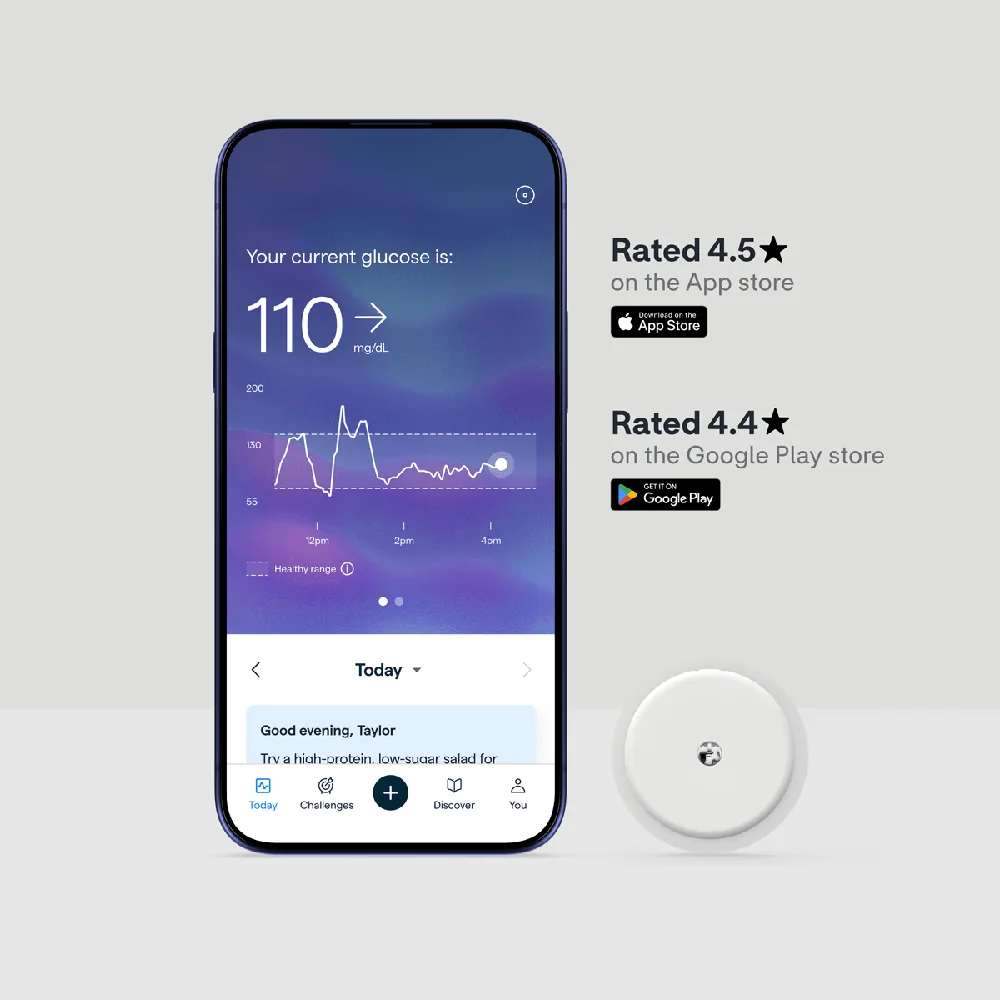
Biolinq Shine is a glucose sensor you read by glancing at your arm: a quarter-sized patch worn on the inner forearm that glows blue while glucose sits between 70 and 180 mg/dL, yellow above that and red below it. Biolinq announced on 24 September 2026 that the US FDA had cleared it for over-the-counter use, and the agency's letter is dated 18 September. It's meant for adults aged 22 and older who aren't on insulin, and the FDA's description says it can work as a standalone device with no separate phone or display.[1] [2] [3]
Inside the patch, an array of seven microelectrodes sits in the dermis, the skin layer above the fat where conventional glucose filaments end up. IEEE Spectrum's Gwendolyn Rak reported in 2024 that Biolinq etches these onto silicon wafers with chipmaking methods, on 2 mm by 2 mm chips, and that, according to CEO Rich Yang, the display's battery drain caps the first-generation patch at five days of wear. An optional app shows how meals, rest and movement affect glucose.[2] [4] [1]
The FDA concluded that Shine's accuracy suits its intended use, which is general awareness of glucose ranges. The evidence sits in the agency's 2025 De Novo decision summary (the FDA's route for new kinds of device) for the same device. At six US centres between February and June 2024, 202 adults wore Shine for up to five days while blood was drawn every 15 minutes for comparison with a laboratory analyser, with the device's output blinded. Of 190 primary patches, 84.7% were still running on day five.[1] [2] [5]
The colour-only readout is the divisive part. FDA's reviewers read it as a plus for people with limited number literacy or those who find fingersticks painful. USC's Anne L. Peters said in a Medscape commentary after that 2025 decision that the patch gives colours with no numbers or alarms, called it more of a wellness tool, and added that she personally loves seeing the numbers. The pivotal volunteers were adults with diabetes, two in three of them with type 1, enrolled to cover the full glucose range, so healthy wearers aren't in that dataset.[3] [5]
A yardstick for what numeric over-the-counter sensors manage in healthy people comes from Abbott's Lingo, which Yale's Navneet Prakash and colleagues tested on 39 adults aged 18 to 28, in what they call the first independent evaluation of its kind. Against fingerstick readings the overall error averaged 12.9%, readings trailed by about six minutes, and the sensor agreed with overall trends but was less reliable for exact values. Shine wasn't in that study.[6]
Biolinq hasn't said when Shine will go on sale or what a patch will cost: Beyond Type 1 reported on 30 September 2026 that no purchase date had been announced, and the company's own 24 September release gives none. Peters had expected the sensor in early 2026. When it ships, watch three things: the price of each five-day patch, the first reports from wearers without diabetes, and the 10-day second generation Biolinq was aiming for in 2024.[7] [1] [3] [4] [2]
Sources
- Biolinq Incorporated: Biolinq Shine Receives FDA 510(k) Clearance for Over-the-Counter Use (GlobeNewswire release, as hosted by Yahoo Finance), 24 September 2026 ↗
- U.S. FDA: 510(k) clearance letter, indications for use and 510(k) summary K262599 for Biolinq Shine Autonomous Time-in-Range Microsensor, 18 September 2026 ↗
- Anne L. Peters, MD / Medscape: Biolinq Shine: New Sensor Doesn't Require Needle to Measure Glucose (video commentary transcript), 20 October 2025 ↗
- Gwendolyn Rak / IEEE Spectrum: Microneedle Glucose Sensors Keep Monitoring Skin-Deep, 11 June 2024 (August 2024 print issue) ↗
- U.S. FDA: De Novo decision summary DEN240080, Biolinq Shine Autonomous Time-in-Range Microsensor ↗
- Prakash N, Barrows AH, Stults-Kolehmainen M, Loza AJ, Kilpatrick MW, Ash GI: Agreement of Over-the-Counter Continuous Glucose Monitors With Capillary-Meter Glucose in Young Adults Without Diabetes, Journal of Diabetes Science and Technology, online ahead of print 20 September 2026 ↗
- Christine Fallabel / Beyond Type 1: Can You Monitor Glucose Without A Needle Or A Prescription? FDA Clears A New Biosensor, 30 September 2026 ↗