National University of Singapore's eLuminator electronic skin glows where you press, down to fingerprint ridges
It has no pixel grid and doubles as a digital pressure sensor. The lab demonstrations ran on 150 volts of alternating current, and lowering that is the step its authors name towards battery-powered wearables.
 SmartWearGuide · 2026-10-30

At a glance
Skip it if: you need a battery-powered wearable; the demos ran at 150 volts and 1 kilohertz.
Status: bench result published in Nature Communications in May 2026; the next step is lighting at a battery's voltage.
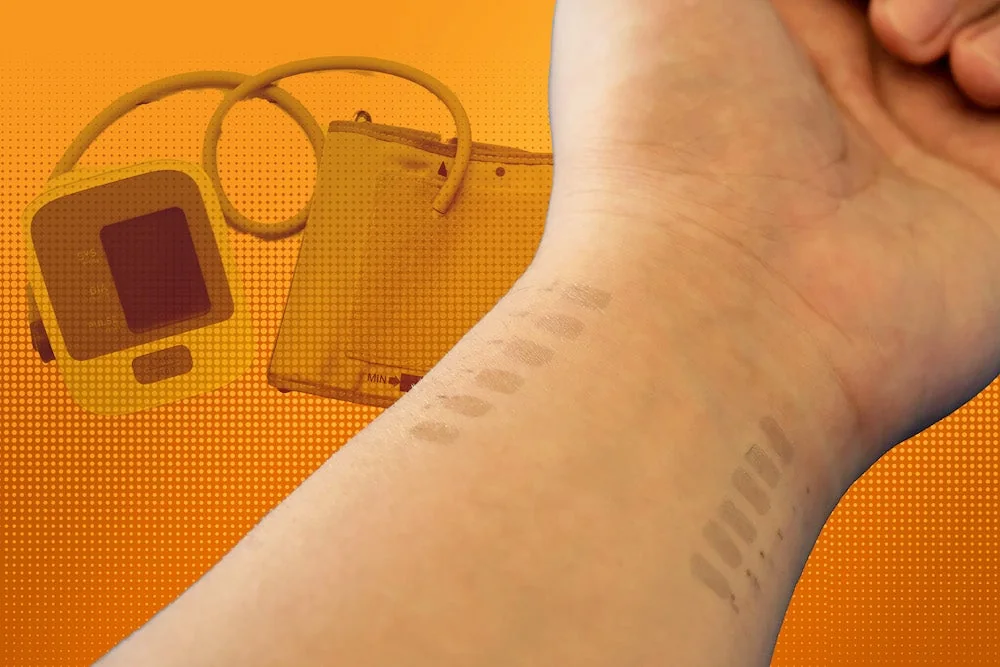
Press a fingertip onto eLuminator, the skin from the National University of Singapore (NUS), and the ridges of the print appear as light, with no grid of sensor pixels behind them. The skin is about 70 micrometres thick, and its authors calculate a resolution limit of 847 dots per inch from a 30-micrometre dome spacing. The paper appeared in Nature Communications in May 2026, and NUS announced the work on 28 September 2026.[1] [2]
The skin is a three-layer sandwich: a top electrode with microscopic domes, a middle layer of copper-doped zinc sulphide phosphor in a rubbery fluoropolymer, and a transparent bottom electrode. Under alternating current the phosphor stays dark until pressure squashes the domes, which strengthens the electric field and brightens the glow where the press is harder. The same stack works as a capacitor, so a multimeter can read pressure digitally. The film physically stretches past 100% strain, with its conductive top layer holding electrically to 50%.[1]
A fingerprint, whose ridges sit 300 to 700 micrometres apart, came out as a high-contrast light map, and a 10-micrometre sensing layer depicted pillar arrays equal to 63 and 127 dpi while a 200-micrometre layer blurred the detailed ones. At low pressures light output climbs by 1.12 candela per square metre for each kilopascal, the optical response takes about 15 milliseconds and the digital readout about 110, and the range reaches 180 kilopascals. The skin stayed stable through 4,000 press cycles up to 10 kilopascals and 1,000 bends.[1]
Two demonstrations point to uses. A 4 cm by 4 cm patch on a transparent box glowed under a 3D-printed foot model while a camera turned the light into a pressure map, which the authors pitch towards diabetic foot care. A 1 cm by 2 cm patch on a laparoscopic grasper, a keyhole-surgery tool, brightened as force rose on artificial tissue, and the thin sensing layer gave a sharper contact edge, 0.64 millimetres wide against 1.56 for the thick one.[1]
Power is the gap between this bench result and a wearable. The application demos ran at 150 volts and 1 kilohertz, which the authors settled on after noting that very high voltages over long periods can break down the light layer, and they name high-k dielectrics or structural redesign as the way to cut the voltage towards battery-powered wireless wearables. A September 2026 Communications Chemistry paper on light-emitting textile fibres, from Wuhan Textile University, calls 200 volts conventional for such displays and flags possible biological risks even at its 45-volt turn-on.[1] [3]
Pixel-free light-up skin has precedent. A 2020 Nature Communications paper from Seoul National University and the Korean institute ETRI described a 3-micrometre skin that showed 1,016 dpi micro-bumps, with its pressure response measured at a 15-volt bias, and NUS's paper cites it for seven coating layers. NUS argues for a three-layer build in non-toxic materials with a digital channel beside the light, and its own pillar tests sit below the 847 dpi limit. NUS's paper is open access to read in full; the follow-up to watch is one that lights at a battery's voltage.[4] [1]
Sources
- Zixiong Wu, Shuwen Chen, Shicheng Fan, Zheng Qiao, Jiaming Qi, Yusheng Zhang and Chwee Teck Lim / Nature Communications: Strain-localized luminescent e-skin for high-resolution pressure mapping and visual force feedback, 26 May 2026 ↗
- National University of Singapore / PR Newswire: NUS team unveils electronic skin that lets users "see" touch instantly, 28 September 2026 ↗
- Guangyou Liu et al. / Communications Chemistry: Low-voltage driven anticounterfeiting textile display based on alternating current electroluminescent fibers, 25 September 2026 ↗
- Byeongmoon Lee, Ji-Young Oh and colleagues / Nature Communications: Ultraflexible and transparent electroluminescent skin for real-time and super-resolution imaging of pressure distribution, 31 January 2020 ↗